Darkness and light
Heart of DarknessDarkness and light are not stable opposites in Heart of Darkness. Light can suggest knowledge, civilization, or moral purpose, but it also illuminates scenes of exploitation and lends persuasive force to imperial claims; darkness can mark danger and uncertainty, yet it also exposes the violence hidden beneath those claims. In Marlow’s narration, landscapes, work, eloquence, and the limits of memory make this contrast a problem of both ethics and perception: what appears enlightened may be destructive, while what seems incomprehensible may reveal a shared humanity.
Historical Light and the Imperial Claim
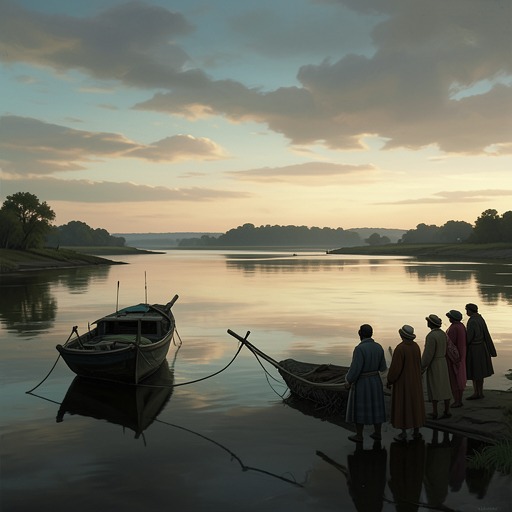
The frame narrative establishes the contrast before Marlow recounts his journey. On the Thames, the city’s lights appear as evening settles, while the place of London is described as a gloom beneath the sky. The river carries the suggestion of past voyages and their grand consequences, but Marlow interrupts any simple celebratory account by calling England itself one of the dark places of the earth. The remark turns the familiar landscape into a challenge to the assumption that darkness belongs only to distant territories.
Marlow develops that challenge through an imagined Roman commander sent north nearly two thousand years earlier. The commander encounters a cold, difficult country, with little food, unfamiliar conditions, and the constant threat of disease and death. The episode makes the supposed civilizing light of Rome look temporary and precarious: against a long human history, what later generations call illumination may be only a brief flare. Marlow’s image of people living in a flicker gives light a limited duration rather than the authority of permanent progress.
His judgment of conquest is correspondingly severe. He distinguishes the idea invoked to justify domination from the material conduct of conquerors, describing imperial rule as seizure and violence rather than a disinterested civilizing project. In his account, conquest can claim moral legitimacy only through a genuinely held idea, not through a sentimental pretense. This distinction creates a standard against which the conduct of the Company and Kurtz can be measured: declarations of benevolence are not themselves evidence of moral light.
The Stations and the Work of Darkness
At the Company’s Outer Station, Marlow encounters a landscape marked by neglected machinery and purposeless blasting. The activity is called railway construction, but the visible work does not appear to advance toward a clear practical end. Nearby, African laborers are being transported under guard and compelled to work; the language of criminal punishment makes their treatment seem administratively justified, while their circumstances expose the violence beneath that description. A uniformed guard treats Marlow as a participant in the same cause, implicating the newcomer in a system whose moral claims he has not accepted.
Marlow turns aside rather than pass the laborers on the hill and finds other workers who have been brought from the coast under contracts. Unfamiliar conditions and inadequate sustenance have left them sick and unable to work; the Company permits them to withdraw and die apart from the activity of the station. Their plight contradicts the idea that organized labor and European administration necessarily bring progress. The station’s daylight does not make its operations transparent in any ethical sense: the people whose labor sustains the enterprise become marginal to its official account of work.
The contrast recurs on the journey to the Central Station. Marlow travels with a caravan of sixty men over two hundred miles, through abandoned settlements and routes where carriers bear heavy loads. He describes the routine of camping, cooking, sleeping, and marching, interrupted by carriers who die on the way. A European official claims responsibility for maintaining the road, but Marlow sees little evidence of its upkeep; an African man found dead beside the path makes the claim of administrative improvement ring hollow. Here the language of order and development casts a thin light over a landscape shaped by coercion, absence, and loss.
River, Wilderness, and the Limits of Knowing
As Marlow’s steamer travels farther upriver, darkness becomes a condition of perception as well as a moral image. The waterway seems to return him to an earlier world: forest, silence, shifting channels, and hidden hazards repeatedly command his attention. He must steer around shoals and snags, find fuel, and keep the steamer moving. Such practical demands protect him, he suggests, from attending fully to the larger reality around him. The river is therefore both a material route and a force that unsettles the confidence with which outsiders imagine they understand the country.
The forest’s stillness does not signify peace. Marlow experiences it as an inscrutable presence, while sounds from the shore remain difficult for the travelers to interpret. He refuses to settle the uncertainty by calling the people there inhuman. Their noise and movement instead provoke the disturbing recognition of kinship: the possibility of shared humanity unsettles the boundary by which Europeans distinguish themselves from those they have conquered. The scene complicates the opposition between civilized light and wilderness darkness, since the travelers’ inability to understand does not prove that the people they observe lack meaning or humanity.
This pressure also affects the narration itself. Marlow later insists that an account cannot fully transmit the life-sensation of a period of experience, its truth and subtle meaning. Darkness thus names not only what is hidden in the forest, but also the limits of explanation. The story’s incomplete and dreamlike quality makes readers confront the gap between seeing events and comprehending them; verbal fluency cannot guarantee full knowledge any more than physical light guarantees moral clarity.
Eloquence, Death, and the Closing Darkness
Kurtz’s history concentrates the conflict between apparent illumination and moral darkness. He is entrusted with a report for the International Society for the Suppression of Savage Customs, and Marlow recalls its eloquent argument that Europeans could exercise great power for good. Yet the report’s later postscript calls for extermination, setting the language of benevolence against a brutally different conclusion. The contradiction shows how a noble rhetoric can coexist with, or be overturned by, the drive to dominate. Kurtz’s words are not merely a contrast to his conduct: their force helps make the contrast harder to dismiss.
At the Inner Station, the Russian Trader’s admiration and the spectacle of Kurtz’s influence offer another version of the same deception. The chiefs visit Kurtz, and the Trader presents his authority as extraordinary, but Marlow rejects the idea that Kurtz is an object of reverence. When the Trader explains that the heads displayed on stakes belonged to rebels, Marlow notes how readily the Company’s categories shift: people have been named criminals, workers, enemies, and now rebels. The changing labels do not illuminate the system; they reveal how its language can redefine its victims while obscuring the power behind it.
The final contrast between light and darkness appears at Kurtz’s death. Marlow remains at dinner rather than joining the others immediately, placing the small light inside against the surrounding darkness. The lamp marks a limited refuge, not a resolution: Kurtz’s voice has ended, and the pilgrims later bury him. Marlow himself nearly dies soon afterward, but survives and describes his endurance as a further expression of loyalty to Kurtz. In the closing frame, Marlow conceals Kurtz’s last words from his fiancée, and the darkened river under an overcast sky appears to lead toward immense darkness. The ending does not restore a clear division between illumination and obscurity. Instead, the Thames, like the distant river, leaves the reader with the possibility that the darkness exposed abroad belongs to the supposedly enlightened world as well.